
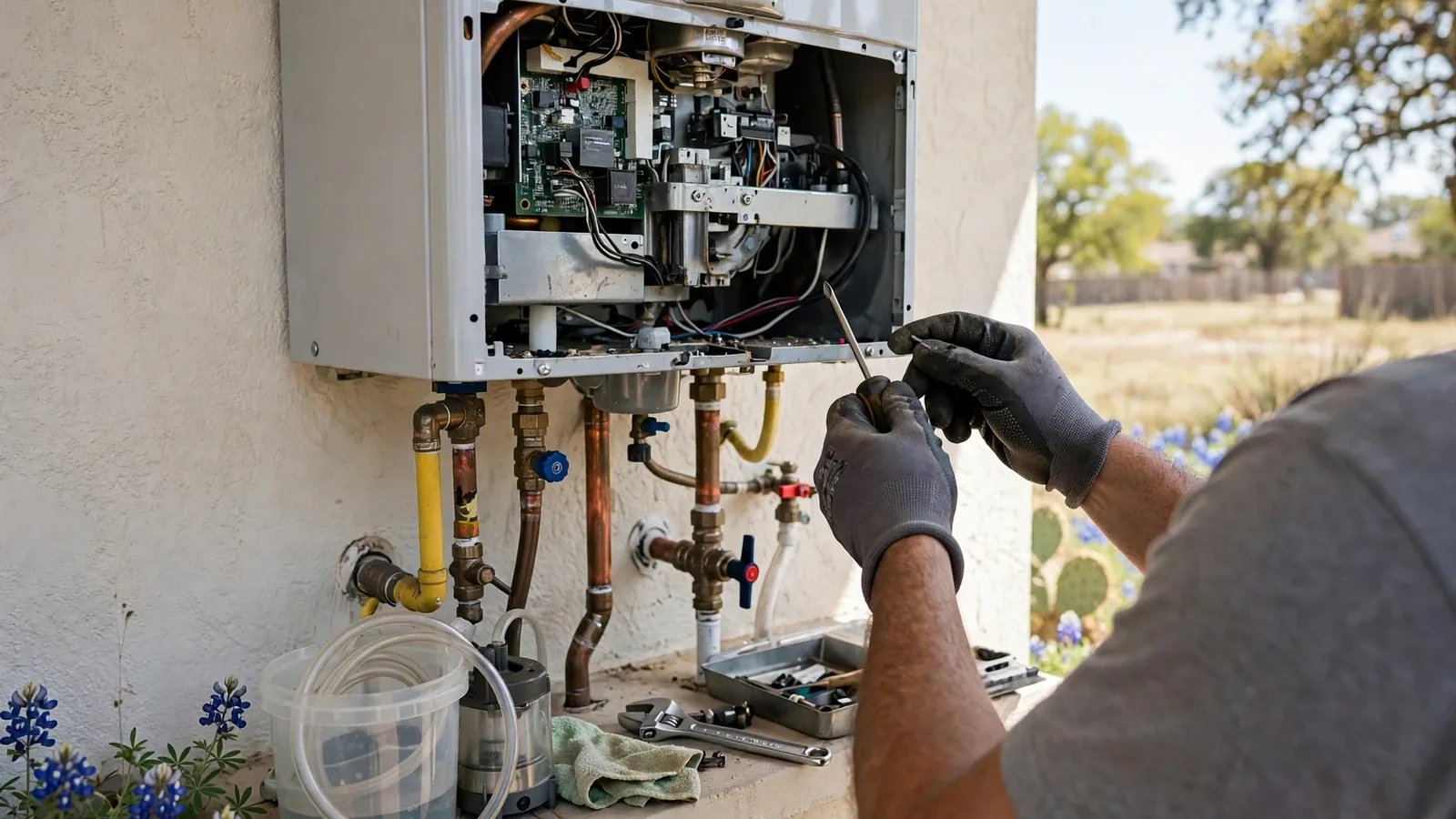
Why a tankless install is more involved
A tank heater stores 40 gallons and heats it slowly. A tankless unit heats water as it flows, so it needs a lot of energy at once. A gas unit can draw 150,000 BTU or more, and an electric whole-house unit can need 100 amps or more across several breakers.
Your existing gas line or panel may not support that. Many installs need a larger gas pipe, a new vent through the wall or roof, or an electrical upgrade. The plumber calculates this before the unit is ordered.
| Item | Gas unit | Electric unit |
|---|---|---|
| Energy supply | Larger gas line, often 3/4 inch | Heavy circuits, often 120 to 150 amps total |
| Venting | Sealed stainless or PVC vent | None |
| Condensate drain | Needed for condensing units | None |
| Isolation valves | Needed for flushing | Needed for flushing |
| Permit | Plumbing and gas | Plumbing and electrical |
Step by step: how an install is done
- Size the unit. Add up the fixtures that run at once and the temperature rise needed.
- Check gas or electrical capacity. Measure the gas line and meter, or the panel and breaker space.
- Remove the old tank. Drain, disconnect and haul it away.
- Mount the unit and set the vent. Follow the manufacturer's clearances for walls and combustibles.
- Connect water, gas and condensate. Add isolation valves and a pressure relief valve where required.
- Test, set the temperature and walk through use. Check for gas leaks, vent draw and hot water at the farthest fixture.
None of these are guesswork. Gas leaks and carbon monoxide are the risks, and venting and clearances are listed in the manufacturer's instructions and the plumbing and fuel gas codes.
A realistic timeline for the job
A straight swap of a gas tank for a gas tankless unit is rarely a one-hour job. Expect the plumber to shut off the water and gas, drain and remove the old tank, mount the new unit on the wall, and run new venting and a condensate drain if the model needs them.
Add time for a gas line upgrade or a new electrical circuit if the existing ones cannot support the unit. Ask your plumber for a clear price before work starts, and ask what is included, such as the permit, the isolation valves for flushing and old unit removal.
Spire, Ameren and Hazelwood water
Gas service in Hazelwood comes from Spire and electric service from Ameren Missouri. For a gas tankless unit, Spire's meter and line size set how much gas can reach the heater. If you smell gas at any time, leave the house and call Spire at 800-887-4173 or 911, then call us for the repair.
Missouri American Water reported hardness at its Missouri River plants from roughly 5 to 13 grains per gallon in 2023, moderately hard to very hard. Hard water leaves scale in a tankless heat exchanger, so plan to flush it on a schedule or add a softener. Test your own tap or ask the utility at 866-430-0820. See water softener and filtration for treatment options.
Gas tankless units are listed to the ANSI Z21.10.3 standard, and the manufacturer's installation manual is the governing document for venting, gas line size and clearances. If a quote does not mention the manual, ask how the installer will confirm those three things.
What the national numbers include
National guides show tankless units installed at $1,400 to $5,600. These add-ons often push a job toward the top of the range.
These are national ranges, not a Hazelwood quote. We give a clear price before work starts.
Can I do a tankless install myself
Some owners can replace one like-for-like electric unit if the circuit already exists. Gas is different. A bad flare, a loose vent or a missed clearance can cause a gas leak or carbon monoxide. Most manufacturers also void the warranty if a licensed plumber does not install the unit.
In St. Louis County, plumbing work is done under a county license, and Hazelwood contracts with the county for plumbing permits and inspections. Florissant's code lets owners of detached single-family homes pull a homeowner permit for their own work but excludes gas lines. Check Hazelwood rules at 314-513-5034 before you start.
Is tankless worth it for your house
A tankless unit gives endless hot water for one long shower and takes less floor space. It can cost less to run, because it does not keep 40 gallons hot all day. But it needs more upfront and more maintenance.
- Good fit: a small family wanting more space and steady hot water.
- Good fit: a house that already has a 3/4 inch gas line and a vent path.
- Poor fit: a tight budget and a wall with no vent route.
- Poor fit: a house with several showers running at once and a small gas line.
If your tank is leaking or failing, compare water heater replacement options before you decide. For a straight swap with the same fuel, water heater installation is the quicker path.
When to call a pro
Call a plumber before buying a unit. A short site visit checks the gas line, vent route and panel so you do not buy something the house cannot support. Call right away if you smell gas, see soot on a vent, or notice a pilot out on a gas unit.
We serve Black Jack and Maryland Heights along with Hazelwood, and offer same-day appointments when available.
Frequently asked questions
National cost guides show about $1,400 to $5,600 installed, depending on fuel, venting, gas line or electrical work, and permits.
Sometimes. Many units need a larger line, often 3/4 inch, to supply enough gas. A plumber measures the line and meter first.
Scale can build in the heat exchanger. Missouri American Water reported roughly 5 to 13 grains per gallon at its Missouri River plants in 2023, so flushing or softening is wise.
Leave the house and call Spire at 800-887-4173 or 911. Do not use switches or flames.
Plumbing permits run through St. Louis County via the city. Call 314-513-5034 for Inspections and Permits. A licensed plumber can handle the filing.
Often there is room, but venting and gas or electric supply may need a different route. A site visit confirms it.
Questions about your situation? A licensed plumber is on the line any hour.
Call (855) 575-2890