
What goes in the basement
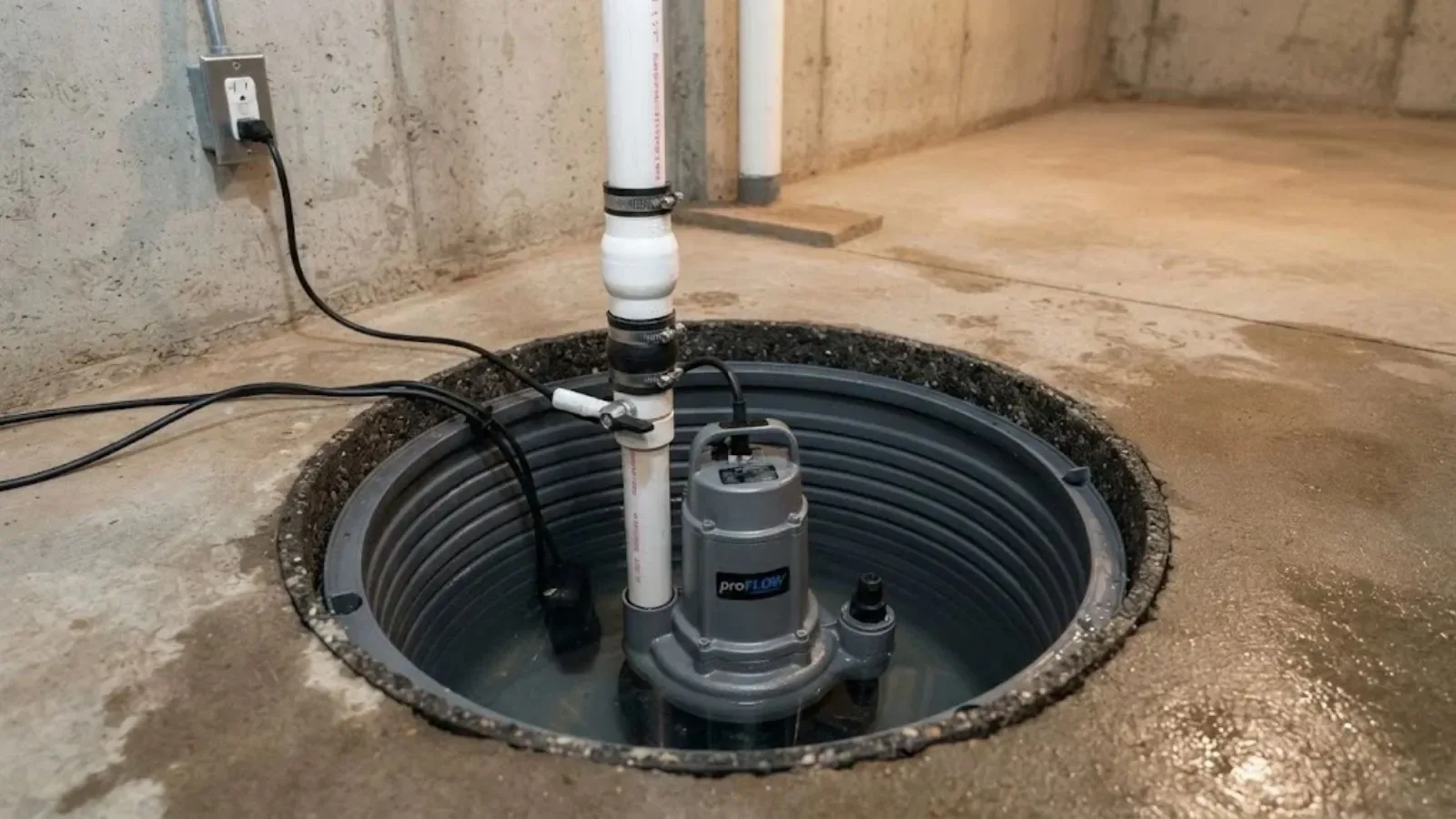
The core of a sump system is a pit. It is usually a plastic liner set into the slab, about 18 inches wide and 22 to 24 inches deep. The pump sits at the bottom on a flat base or a few bricks so silt does not clog the intake. Water seeps in through the gravel under the slab, fills the pit and trips a float switch.
Two parts get skipped on rushed jobs. A check valve on the discharge pipe stops the water in the pipe from falling back into the pit after every cycle. A small hole drilled in the pipe below the valve, called a weep hole, keeps the pump from air locking.
A tight lid keeps out debris and cuts down on humidity and odors. Plug the pump into its own grounded outlet, protected by a ground fault circuit interrupter, and never run it from an extension cord.
Choosing where the water goes outside
The discharge pipe leaves the house through the rim joist or a basement wall, then runs to the surface. The exit point should be above the expected snow line, a few inches above grade, and on the side of the house where the yard slopes away.
The water needs somewhere to land. A splash block is not enough on its own. Run buried or surface pipe at least 10 feet from the foundation, and farther if the lot is flat, so the water does not soak back into the same soil it just left.
| Option | Works well when | Watch out for |
|---|---|---|
| Pipe to a pop-up emitter in the yard | The lot slopes away from the house | The line must slope to drain between cycles |
| Extension onto an open lawn area | You have 10 feet or more of clear yard | Ice sheets on a walkway in winter |
| Tie into a downspout line | The downspout already drains away from the house | Added flow can overload an undersized line |
| Discharge to the sanitary sewer | Almost never | Clean water in the sewer is generally not allowed, so ask MSD first |
Do not point the discharge at a neighbor's property or onto a sidewalk where it will freeze. Both create problems that outlast the storm.
Installation order, start to finish
- Pick the low spot. Water tends to collect at one corner, and the pit belongs there. A plumber often finds it by watching where moisture appears on the slab after rain.
- Break the slab and dig the pit. A concrete saw or breaker opens a square a little wider than the liner. Dig to depth, add a few inches of gravel, and set the liner level.
- Set the pump and plumb the discharge. Use rigid pipe up from the pump, add the check valve with the arrow pointing away from the pit, and drill the weep hole.
- Run the line outside. Core or drill the exit, slope the pipe so it drains toward the outlet, and seal around the opening.
- Patch, wire and test. Pour the slab patch, plug in the pump, and fill the pit with a bucket or hose to watch a full cycle from start to finish.
What drives the price of a sump pump install
National cost guides put a sump pump installed at roughly $600 to $2,500, with an average near $1,600. Replacing an existing pump usually runs $400 to $700. A new drainage system around the footing is a different job and can run $4,000 to $12,000. These are national figures, not a quote.
We give a clear price before work starts, after seeing the basement and the yard.
A sump pump failure from a power outage is a common reason to price a backup unit at the same visit.
Winter and digging notes for Hazelwood yards
The City of Hazelwood publishes a design frost depth of 30 inches and a winter design temperature of 2 degrees F. That matters outside, because a discharge pipe that holds a few inches of standing water will freeze solid on a cold night. Slope the line so it empties after every cycle, and keep buried runs below frost depth or fully pitched so nothing sits in them.
Call 811 before you dig a trench for the discharge line, as the city asks. Gas, electric and water lines run through residential yards, and a buried pipe is not worth hitting Spire or Ameren Missouri lines to install. Plumbing permits in Hazelwood are handled through St. Louis County, so ask about a permit before a larger drainage job.
Sump pumps are listed to the UL 778 standard, and the manufacturer's instructions set the check valve and discharge pipe size. Before you route the discharge anywhere underground, ask MSD, since model plumbing codes generally keep groundwater out of sanitary sewers.
A short checklist before you call a plumber
- Note where water enters, and photograph the spot after a hard rain.
- Locate the electrical outlet and check that it is grounded.
- Walk the yard and mark where the grade slopes away from the house.
- Check the downspouts, since clogged gutters often cause the water you blame on the foundation.
- Write down whether the basement has a floor drain, since that changes the plan.
When to hire a plumber instead of doing it yourself
Setting a replacement pump in an existing pit is a fair weekend job for a handy owner. Cutting a new pit, coring through a foundation wall and running a buried discharge line is more work than it looks. A pit set too shallow or a pipe sloped the wrong way will fail the first time a storm tests it.
Our sump pump installation and repair service covers the pit, the pump and the outdoor line. If water keeps returning even with a working pump, the cause may be larger, and basement waterproofing looks at drainage around the footing. For a pump that runs constantly, a plumber should also check for a hidden supply or drain leak feeding the pit.
We do not set up gutters, regrade lawns or repair concrete flatwork around the house. If your basement floods and the lot slopes toward the foundation, a landscaper may need to be part of the fix. Homeowners in Florissant, Bridgeton and Hazelwood call us for the plumbing side of these jobs.
Frequently asked questions
At least 10 feet is a common rule, and more on a flat lot. The goal is for water to run away and not seep back into the soil beside your foundation.
It can. If standing water sits in the pipe, a hard freeze will block it. Slope the line so it drains after every cycle and keep the outlet clear of snow and ice.
Generally not. Clean groundwater in the sewer is usually not permitted. Ask the Metropolitan St. Louis Sewer District at 314-768-6260 before you connect anything to a sewer line.
Yes. It keeps discharge water from running back into the pit and making the pump cycle again and again.
It should have a dedicated, grounded outlet with ground fault protection. Avoid extension cords, because a tripped breaker during a storm leaves the basement unprotected.
In a yard, it should drain to the surface well away from the house, then follow the natural slope toward the street or a swale. Hazelwood sits among creeks that drain to the Missouri River, but we do not route private discharge lines to any creek or public storm system without checking first.
Questions about your situation? A licensed plumber is on the line any hour.
Call (855) 575-2890