
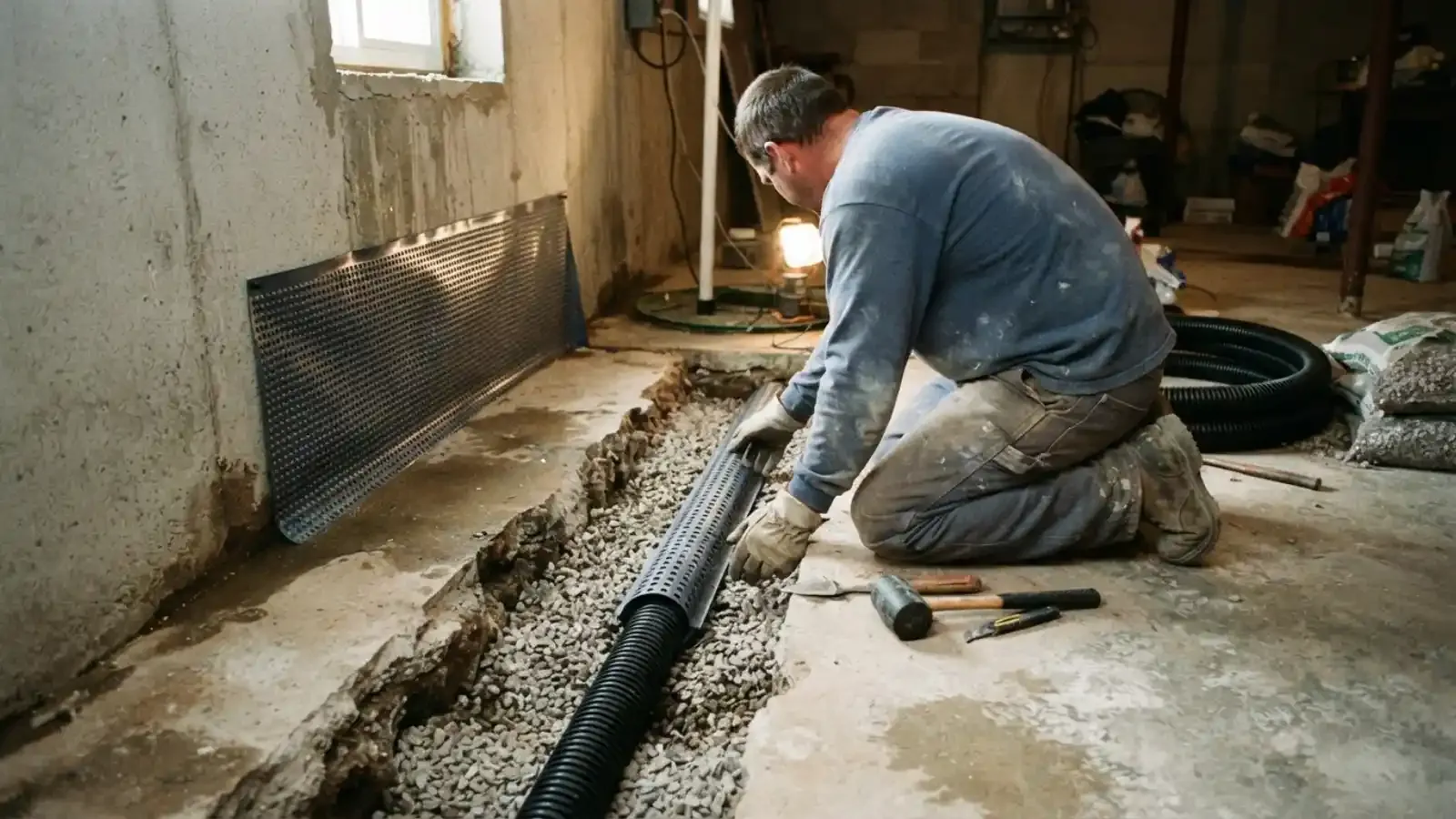
How interior waterproofing works
Water does not need a big hole to get in. When soil around a foundation stays saturated, pressure pushes water up through the joint where the floor meets the wall and through tiny pores in block and concrete.
An interior system accepts that water will arrive and gives it a controlled path. A channel runs along the inside of the footing, collects the water under the slab edge and carries it to a sump pit, where a pump sends it outside.
- Cut the channel. We open a strip of slab along the wall where the floor meets the foundation.
- Lay the drain tile. Perforated pipe goes in the trench, surrounded by clean stone so water moves in and silt stays out.
- Set the sump pit. The pipe drains to a basin with a pump, a check valve and a discharge line.
- Patch the floor. We restore the slab over the channel so the finished floor is flat again.
Where the water comes from
Before any system, we look at where water enters. Wall seepage after a rain, a damp line at the base, and a wet floor along the edges are all signs of groundwater. A damp patch under a single window, or wetness that starts at a downspout, may be a drainage fault outside.
| Sign | Usual source | Likely approach |
|---|---|---|
| Water along the wall-floor joint after rain | Groundwater pressure | Interior drain tile and sump |
| Wet spot below a downspout | Gutter discharge too close | Extend the downspouts first |
| White powder on block walls | Moisture moving through masonry | Reduce moisture, treat the source |
| Stair-step crack with water entering | Foundation movement | Structural specialist |
| Floor damp with no storm | Plumbing leak | Leak detection first |
Want a plumber to look at your basement and explain the options? Call to schedule.
Call (855) 575-2890What we do and what we do not do
We install interior drain tile, sump pits and pumps, and the discharge line that carries the water out. We do not excavate outside the house, and we do not do structural or foundation repair.
If a wall is bowing, a crack is wide or shifting, or the floor has heaved, a structural specialist should evaluate the foundation before anyone seals or drains anything. An inside system manages water. It does not fix a moving wall.
We also do not promise a bone-dry basement. A system that handles groundwater cannot cure humidity or condensation from the air, and a dehumidifier may still be needed.
What affects the price of basement waterproofing
Basement waterproofing is quoted per job, because every foundation is different. We do not post dollar figures for it, since the price swings with the layout of the basement. We give a clear price before work starts, after seeing the space.
Insurance generally does not pay for waterproofing work. A sudden flood from a failed pump may be covered, so ask your insurer.
Saturated ground, frost and permits in Hazelwood
Hazelwood sits close to creeks that drain to the Missouri River, and ground around a house stays wet for days after heavy rain. If your lot is low or slopes toward the foundation, expect water pressure to build during wet weeks.
The City of Hazelwood publishes a frost depth of 30 inches. Frozen soil can seal the ground around the foundation in winter and push thaw water toward the walls in late winter, so the first warm spell is a good time to watch for a wet floor. Plumbing permits in Hazelwood run through St. Louis County, and we handle that paperwork when a system needs one.
The International Residential Code (IRC), which the City of Hazelwood lists in its 2021 edition, covers foundation drainage in section R405 and foundation waterproofing and dampproofing in section R406. Those sections set the standard for how water is meant to be kept away from a basement wall, and an interior system is a retrofit for homes that did not get it right.
Fix the outside first
Many wet basements get better with cheap outdoor changes. Clean the gutters, extend each downspout several feet from the wall, and keep soil sloped away from the house.
If the floor still seeps after that, an inside system is the next step. The sump pit at the end of it is covered on our sump pump installation and repair page. If a wet floor shows up with no storm at all, a hidden supply or drain leak is a better suspect, and leak detection can rule it in or out.
For homes in Bridgeton, our Bridgeton page covers service on that side of Lambert.
Frequently asked questions
A drain channel along the inside of the footing, perforated pipe set in stone, a sump pit with a pump and a discharge line, and a patched slab. It collects water that gets under the floor and sends it outside.
No. We do not excavate outside the house and we do not do structural or foundation repair. A cracked or bowing wall should be seen by a structural specialist.
Groundwater shows up after rain and along the edges of the floor. A plumbing leak keeps going on dry days and is often near a pipe, a water heater or a washer. We can help sort out which one you have.
It removes standing water and seepage, which helps. Musty air also comes from humidity, so you may still need a dehumidifier or better ventilation.
It depends on the length of wall, the floor type, the pit and the discharge route, so we do not post a figure. We give a clear price before work starts, after seeing the basement.
Plumbing permits for Hazelwood run through St. Louis County, and work should be done by a licensed plumber. We handle the paperwork when a job needs a permit.
Questions about your situation? A licensed plumber is on the line any hour.
Call (855) 575-2890