
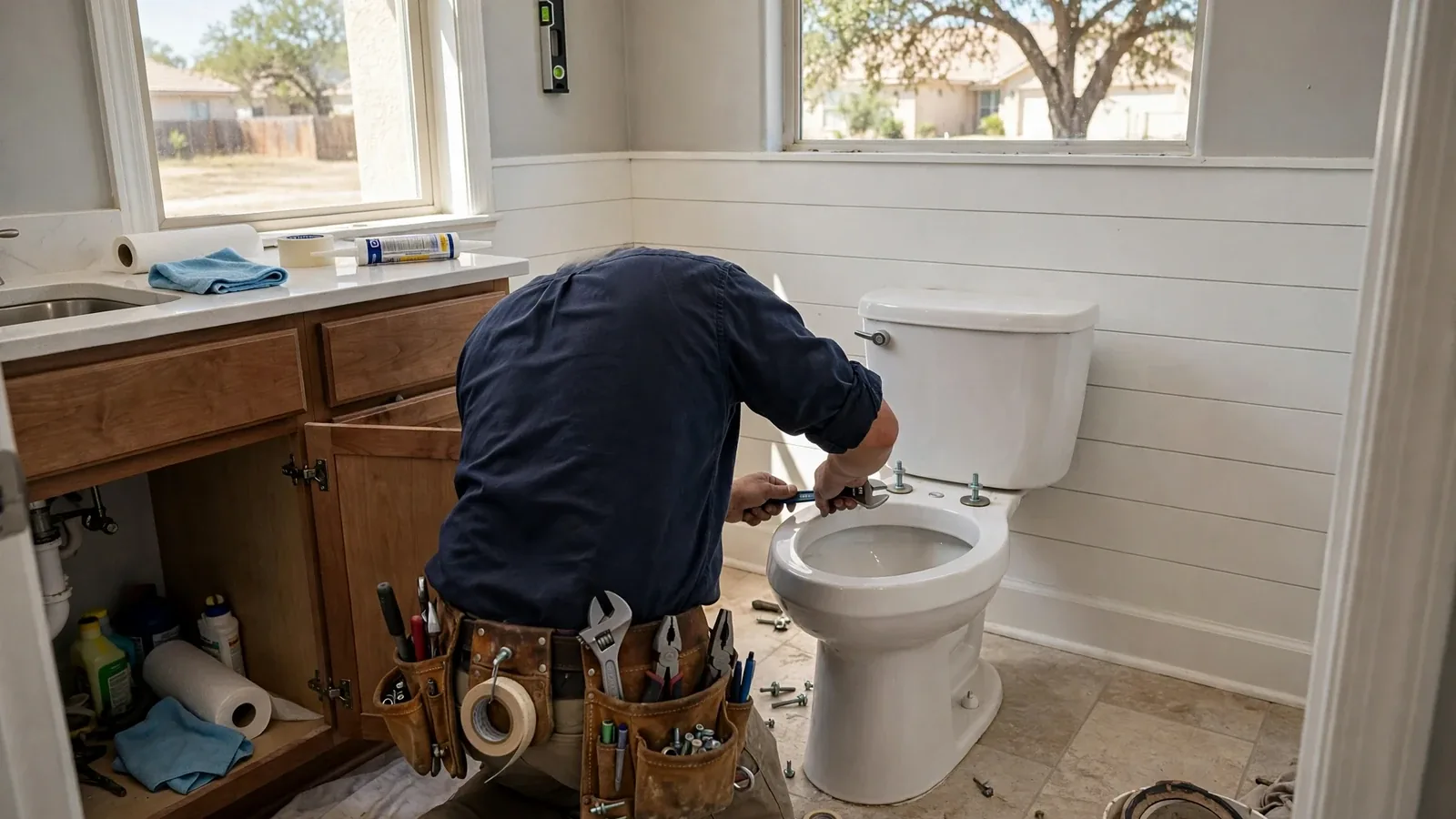
When a toilet is an emergency
A toilet still rising toward the rim can be stopped in about ten seconds. Lift the tank lid, press the rubber flapper down over the opening at the bottom, then turn the stop valve on the wall behind the bowl clockwise until it stops. Do not flush again.
Water that keeps coming, or sewage showing up in a tub or floor drain, means the clog sits further down the line than the toilet. Shut off the main water valve if the floor is wet and call us any hour. We offer same-day appointments when available, and we can tell you over the phone which fixtures to leave unused.
- Bowl rising toward the rim and not draining.
- Water spreading from the base of the toilet.
- Supply line or tank spraying or dripping onto the floor.
- Gurgling or sewage in a nearby tub, shower or floor drain.
- The only bathroom in the house is out of service.
Why a toilet keeps running
A running toilet wastes water all day and rarely makes enough noise to warn you. Most of the time the flapper is not sealing, the chain has the wrong slack, or the fill valve is not shutting off at the right level. Put a few drops of food coloring in the tank and wait 15 minutes. Color in the bowl means the flapper is leaking.
| What you notice | Usual cause | Typical fix |
|---|---|---|
| Runs a minute after flushing or restarts on its own | Worn flapper or a chain with the wrong slack | New flapper, chain adjusted |
| Water trickles into the overflow tube | Fill valve set too high or failing | Adjust or replace the fill valve |
| Weak flush and slow refill | Mineral buildup in the rim jets or a partial clog | Clean the jets, auger the trap |
| Water pooling at the base | Failed wax ring or loose closet bolts | Reset the toilet on a new seal |
| Toilet rocks side to side | Loose bolts or an uneven flange | Reseat and shim, or repair the flange |
Clogs, plungers and knowing when to stop
Use a flange plunger, the kind with a rubber sleeve that folds out of the cup, because it seals the toilet outlet better than a flat sink plunger. Push gently first to clear the air, then pump with steady strokes for about 20 seconds. If the water drops, flush once and watch the bowl before you trust it.
A toilet auger gets past the bend in the trap without scratching the porcelain, which a metal coat hanger will. Toys, wipes and thick paper are the usual finds.
If the plunger and auger fail, or the same toilet clogs again within a day or two, the blockage is probably past the toilet. That is a job for drain cleaning, and we can run a camera if the clog keeps coming back.
Water still rising? A plumber is on the 24/7 line. Call before the bowl reaches the rim.
Call (855) 575-2890Wax rings, rocking toilets and leaks at the base
A wax ring is a donut of wax between the toilet outlet and the floor flange. It seals water and sewer gas in. When it fails you see water at the base after a flush, smell sewer gas, or feel a soft spot in the floor.
- Shut off and empty. We close the stop valve, flush the tank, and sponge out the bowl.
- Lift and inspect. The flange, bolts and the floor around them are checked for cracks and rot before anything goes back.
- Reset on a new seal. A new wax ring or wax-free seal goes down, and the toilet is set level and tightened evenly.
- Test for leaks. We flush several times and watch the base, the supply line and the tank bolts.
If the subfloor around the flange is soft, a new ring will not hold. We tell you that before the toilet goes back, because the floor repair has to come first.
Repair it or replace it
Replacement makes sense when the porcelain is cracked, the toilet clogs often even on a clean drain, or repairs keep stacking up. A crack in the tank or bowl leaks and cannot be sealed. Older toilets that use 3.5 gallons or more per flush are also worth swapping, since WaterSense labeled models use 1.28 gallons or less.
An install covers removing the old toilet, checking the flange, setting the new one on a fresh seal, fitting a new supply line and testing it. Moving a toilet to a different spot in the room means new drain and vent piping, which we handle as plumbing installation. We do not patch cracked porcelain.
What toilet work costs
National cost guides put a typical installed toilet at $350 to $800, with an average near $600, and a repair at $130 to $300. Those are national ranges, not a local quote.
We give a clear price before work starts, once we have seen the toilet and the floor under it.
If an overflow soaked flooring or drywall, ask your insurer about water damage coverage before you tear anything out, and take photos first.
Hazelwood water and the rubber parts in your tank
Missouri American Water, which supplies Hazelwood, uses chloramines as its disinfectant, according to its 2023 annual water quality report. Chloramines are hard on rubber parts such as flappers and fill valve seals, which can soften, warp or turn slimy. If your flapper feels sticky or the toilet starts running again soon after a repair, that wear is the usual reason.
When we replace a flapper we suggest a chloramine-resistant one, and we suggest you look at it every year or two. The same report put hardness at the Missouri River plants at roughly 5 to 13 grains per gallon in 2023, so mineral crust on the rim jets and fill valve is common. Test your own tap, or call Missouri American Water at 866-430-0820, to see what your street gets.
Toilets sold in the United States are limited to 1.6 gallons per flush by federal law, and EPA WaterSense labels models at 1.28 gallons or less. Bowls are made to ASME A112.19.2, which is the standard that covers vitreous china fixtures.
Related fixtures and water quality
A bathroom sink that drips or a shutoff valve that will not close is handled on our faucet repair page. If scale keeps clogging jets and valves, water softener and filtration addresses the cause. We take toilet calls from Hazelwood and from nearby towns such as Florissant.
Frequently asked questions
Yes. The line is open 24 hours a day, seven days a week. Close the stop valve behind the toilet, call, and we will schedule the visit with same-day appointments when available.
Lift the tank lid and press the flapper closed, then turn the stop valve behind the bowl clockwise. If water is still reaching the floor, shut off the main water valve.
The new flapper may not match the opening, the chain may be too tight, or the seat under it may be pitted with mineral scale. A failing fill valve produces the same symptom, so we check all three.
Missouri American Water uses chloramines, and chloramines wear rubber parts faster than plain chlorine does. A chloramine-resistant flapper helps, and checking it every year or two catches a failing one before it wastes water.
Permits for plumbing in Hazelwood run through St. Louis County. A like-for-like swap is usually minor, but the city's Inspections and Permits office at 314-513-5034 can confirm whether your job needs one.
National guides list $350 to $800 installed and $130 to $300 for a repair. Those are national figures, so we give you a clear price before work starts.
Questions about your situation? A licensed plumber is on the line any hour.
Call (855) 575-2890