
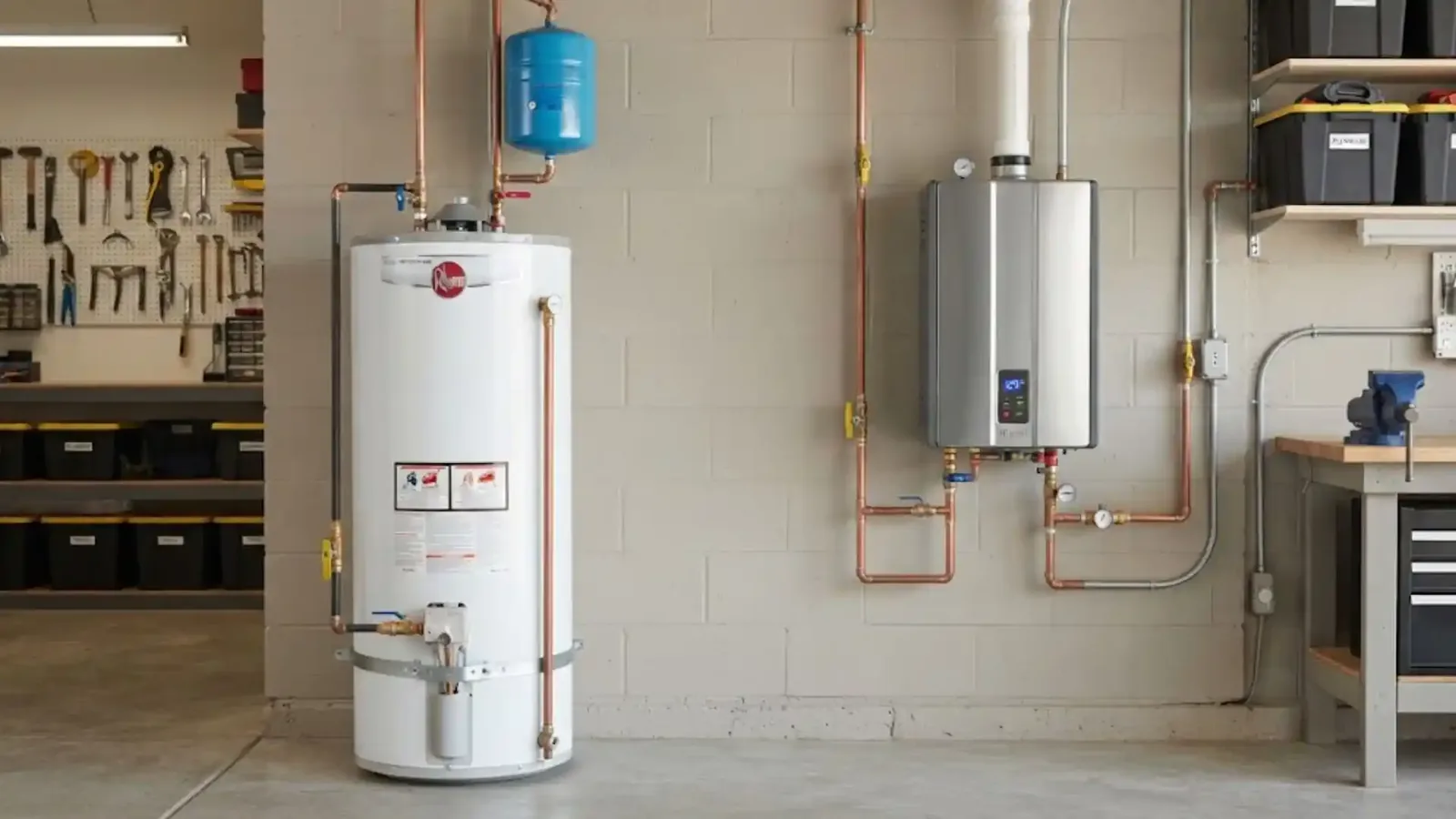
Why gallons do not translate to gpm
A 40 gallon tank holds hot water in reserve and gives a first-hour supply near 50 to 60 gallons. Once the tank runs out, you wait for it to recover. A tankless unit has no reserve, so it must heat water as fast as you use it.
That means the limit is flow, not volume. A tankless heater can run all day on one shower and then stall when a second fixture opens. Sizing is about the peak moment, not the daily total.
Step 1: add up the fixtures that run at once
List the fixtures that might run together at your busiest time. Use the flow rates below, which are typical for modern fixtures. Add the ones you expect to overlap.
| Fixture | Typical flow (gpm) | Notes |
|---|---|---|
| Showerhead | 2.0 to 2.5 | Federal maximum is 2.5 |
| Bathroom faucet | 0.5 to 1.5 | Often mixed, so about half is hot |
| Kitchen faucet | 1.5 to 2.2 | Often mixed |
| Dishwasher | 1.0 to 1.5 | Heats its own water on some cycles |
| Washing machine | 1.5 to 3.0 | Warm cycle uses hot |
| Soaking tub | 4.0 to 6.0 | Large fill rates |
Two showers and a dishwasher at once is about 5 to 6 gpm. One shower and a kitchen faucet is about 4 to 4.5 gpm. Those totals set the minimum flow rate your unit must hit.
Step 2: figure the temperature rise
Temperature rise is the difference between the water coming into the house and the temperature you want, usually 120 degrees F. A unit that gives 7 gpm at a 40 degree rise may only give 4 gpm at a 70 degree rise.
Cold incoming water cuts the flow you can get. Measure your own cold water in winter, since it will be the lowest. A unit sized for summer water will disappoint in January.
- Measure incoming water. Run a cold tap for a few minutes in winter and check it with a thermometer.
- Subtract from 120. The result is the rise your unit must deliver.
- Read the manufacturer's chart. Match the rise and the flow you need to a model's rated gpm.
- Add a margin. Many plumbers choose a unit one size up to stay ahead of cold days and scale.
Hazelwood winter conditions and sizing
The City of Hazelwood publishes a winter design temperature of 2 degrees F and a frost depth of 30 inches. Those figures are air and soil, not your tap water, but they tell you the system should be sized for a cold winter day, not an average one. Measure your own incoming water in January and size to that number.
Gas tankless units also depend on the gas line. Spire supplies gas in Hazelwood, and a unit rated at 150,000 BTU or more may need a larger pipe than a 40 gallon tank used. Ask your plumber to measure before you pick a size.
The federal efficiency metric on a water heater's yellow EnergyGuide label is the Uniform Energy Factor (UEF), set by the Department of Energy's test procedure, a federal standard. Compare UEF between models, and size by flow rate and temperature rise, not by the gallon number of the tank you are replacing.
How size affects the price
National guides list tankless installs at $1,400 to $5,600, and replacing a 40 gallon tank at $600 to $3,000. A bigger unit costs more, and so do the pieces behind it.
National ranges, not a Hazelwood quote. We give a clear price before work starts.
Gas or electric
Gas units deliver more flow for the size. A gas unit rated near 199,000 BTU can heat a lot of water at a 70 degree rise. Electric whole-house units need a lot of amperage, often more than a small panel can spare.
A small electric point-of-use unit can serve one sink or a shower. It will not replace a 40 gallon tank for a whole house. If your home is electric and the panel is full, an electric tankless may need a panel upgrade, which adds to the cost.
- Gas: higher flow, needs venting and a larger line.
- Electric: no vent, needs heavy circuits.
- Heat pump tank: another option when tankless does not fit.
Rules of thumb that work and ones that do not
A common rule says one bathroom needs 5 gpm and two or three baths need 7 to 9 gpm. It is a starting point. A house with a soaking tub or a body-spray shower needs more.
Do not size by the number of people alone. A family of two with a big tub can need more than a family of four with low-flow showers. Count the fixtures and the overlap.
If you are comparing tank and tankless for a worn-out heater, see water heater replacement, and for the install steps see water heater installation.
When to call a plumber
Call before you buy. A short visit confirms the gas line, vent route and panel, and a plumber can run the numbers for your fixtures. If your tank is leaking now, shut off the cold water supply and call our 24/7 line.
We serve Florissant and Bridgeton as well as Hazelwood. We offer same-day appointments when available, and we give a clear price before work starts.
Frequently asked questions
Most homes land between 5 and 7 gpm at the temperature rise they need. A small one-bath home may use 4 to 5 gpm and a larger house 7 gpm or more.
Measure the incoming cold water in winter and subtract it from 120 degrees F. That number is the rise the heater has to deliver.
No. An oversize unit costs more and may need a larger gas line and vent. Size to your peak use plus a modest margin.
Yes. The city lists a winter design temperature of 2 degrees F, so size for cold January water, not summer.
National guides show about $600 to $3,000 for a tank replacement and $1,400 to $5,600 for a tankless install.
Sometimes, but whole-house electric units need heavy circuits. A plumber checks your panel first.
Questions about your situation? A licensed plumber is on the line any hour.
Call (855) 575-2890