
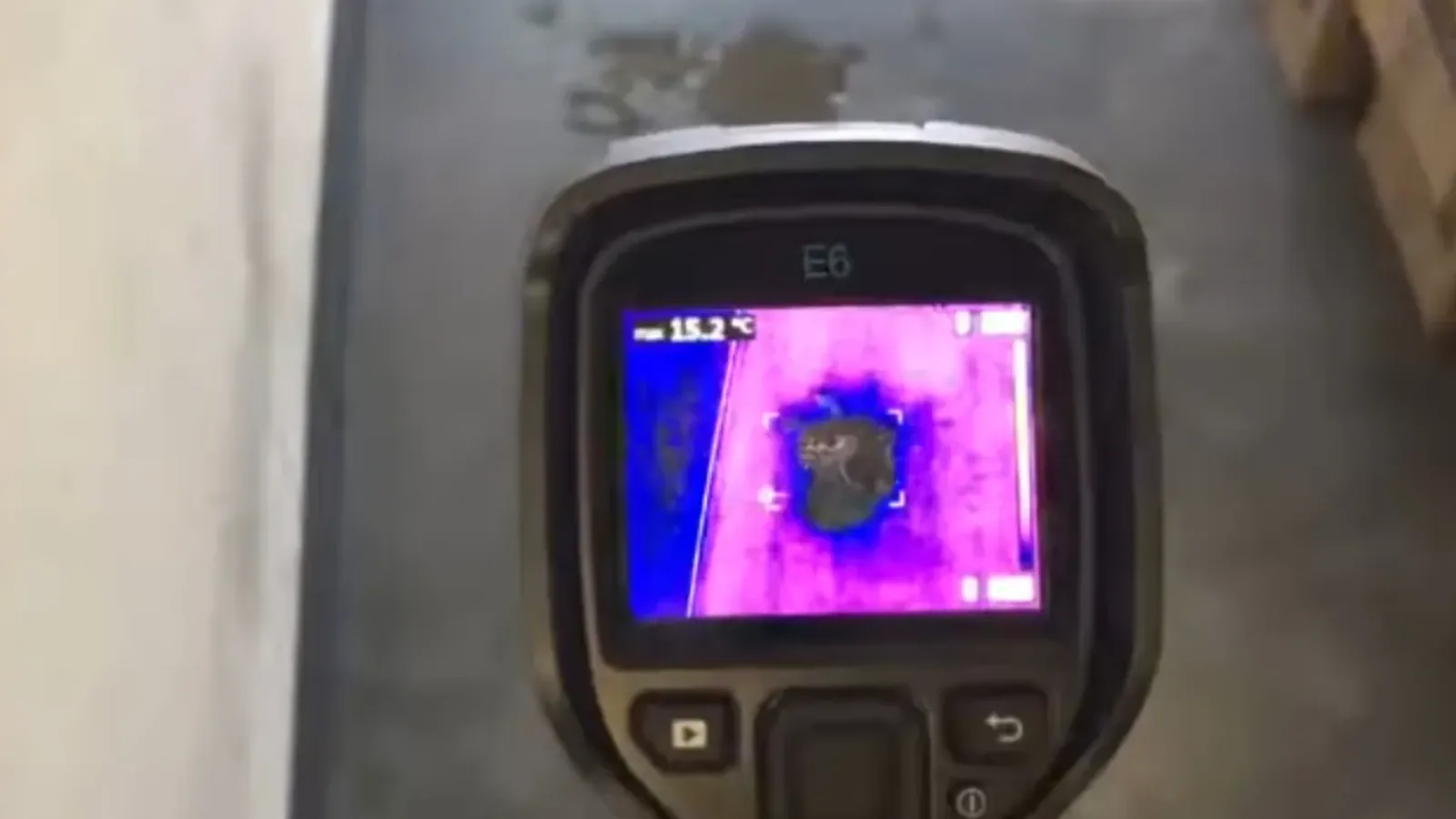
How a thermal camera sees a leak
A thermal camera does not see water. It sees surface temperature. Evaporating water cools a surface, so a damp patch of drywall often shows up as a darker area on the screen. A hot water line leaking into a wall can show the opposite, a warm streak.
The camera works best when there is a clear contrast. A leak behind a plain interior wall in a heated room is a good case. A thick concrete slab, a cold basement wall or direct sunlight on the surface makes the picture harder to read.
Where infrared helps and where it struggles
| Situation | Infrared result | Why |
|---|---|---|
| Wet drywall below a bathroom | Often useful | Moisture cools the wall surface |
| Hot water line in a wall | Often useful | Leaking hot water warms the surface |
| Cold supply line in a slab | Limited | Concrete hides the temperature change |
| Old dried stain from a past leak | Misleading | No active moisture to detect |
| Condensation on cold pipes | Misleading | Looks like a leak but is not |
| Underground yard pipe | Rarely useful | Soil depth blocks the signal |
What a plumber does around the camera
- Ask what you have noticed. Stains, a musty smell, the sound of running water, a spinning meter or an odd bill are all clues.
- Run a meter check. With every fixture off, a moving meter dial suggests a leak somewhere on the property.
- Scan with the thermal camera. The plumber sweeps likely walls, ceilings and floors and notes anything that looks off.
- Confirm with a moisture meter. A probe reads moisture in drywall or wood, which tells you whether a cool patch is actually wet.
- Use other tools if needed. Pressure tests, acoustic listening and a camera in the drain help pin down the exact spot.
The last step is why infrared is only one piece. A plumber who opens a wall based only on a thermal image can cut in the wrong place.
Honest limits you should know
- It cannot tell a leak from condensation, a sweating pipe or a humid corner without a second test.
- It does not see through metal ductwork, thick tile or a concrete slab well.
- It shows a surface, so a leak deep inside a wall may only show a faint pattern.
- It cannot date a leak. A stain may be from a repair that was already done.
- Results change with room temperature, season and how long the leak has been running.
That is not a reason to skip infrared. It is a fast, non-invasive first look that can save a wall from needless cuts. Treat it as a clue, then confirm.
What affects the cost of a leak search
We do not quote a dollar range for leak detection here, because no reliable national range exists for it. The price depends on what the job takes, and we state a clear price before work starts.
Check with your insurer about water damage coverage before repairs, since some policies cover sudden leaks and not slow seepage.
Hazelwood winter conditions that cause hidden leaks
The City of Hazelwood lists a frost depth of 30 inches and a winter design temperature of 2 degrees F. Pipes in exterior walls, crawl spaces and unheated garages can freeze and split, and the leak often shows only after a thaw. Missouri American Water crews handled 16 main breaks in one day during the January 2024 cold snap, and a local plumber reported more than 180 calls in a day.
That pattern is useful to you. After a hard freeze, check walls and ceilings for new stains once temperatures rise, and learn where your main shutoff is. If the meter spins with everything off, call Missouri American Water at 866-430-0820 to ask who owns the pipe, then bring in a plumber.
Thermographic inspection standards, such as ASTM C1060 for wall insulation, depend on a temperature difference between wet and dry material. That is the reason infrared works well in some conditions and shows nothing in others.
When to call a plumber
Call when you see a ceiling stain growing, hear water running with fixtures off, find a warm spot on the floor, or see a bill that jumps with no change in use. Do not cut drywall to look. A plumber can usually narrow the spot first.
Our leak detection service combines a meter test, listening and thermal scans so one tool's blind spot does not hide the cause. If the culprit is a split line, burst pipe repair covers the fix, and a failing line under the yard is a job for water line repair and replacement. Homeowners in Black Jack and Bridgeton use the same process.
We do not guarantee that a thermal scan will find every leak, and we say so up front.
Frequently asked questions
It can show a temperature difference on the wall surface, which may indicate moisture. It does not see the pipe itself, so the result needs a second test.
It is a good screening tool in the right conditions, but not proof. Condensation, old stains and thick materials can fool it.
Rarely well. Concrete hides the temperature change, so plumbers use pressure tests and acoustic listening there.
A water meter check. Turn off every fixture and see whether the dial or low-flow indicator still moves.
Frozen pipes split while ice holds the water in. When the ice melts, water flows through the crack. The City of Hazelwood lists a 30 inch frost depth and a 2 degree F winter design temperature, so freezing is a real risk in exposed pipes.
Some policies cover detection when a sudden leak caused damage. Ask your insurer before work starts.
Questions about your situation? A licensed plumber is on the line any hour.
Call (855) 575-2890