
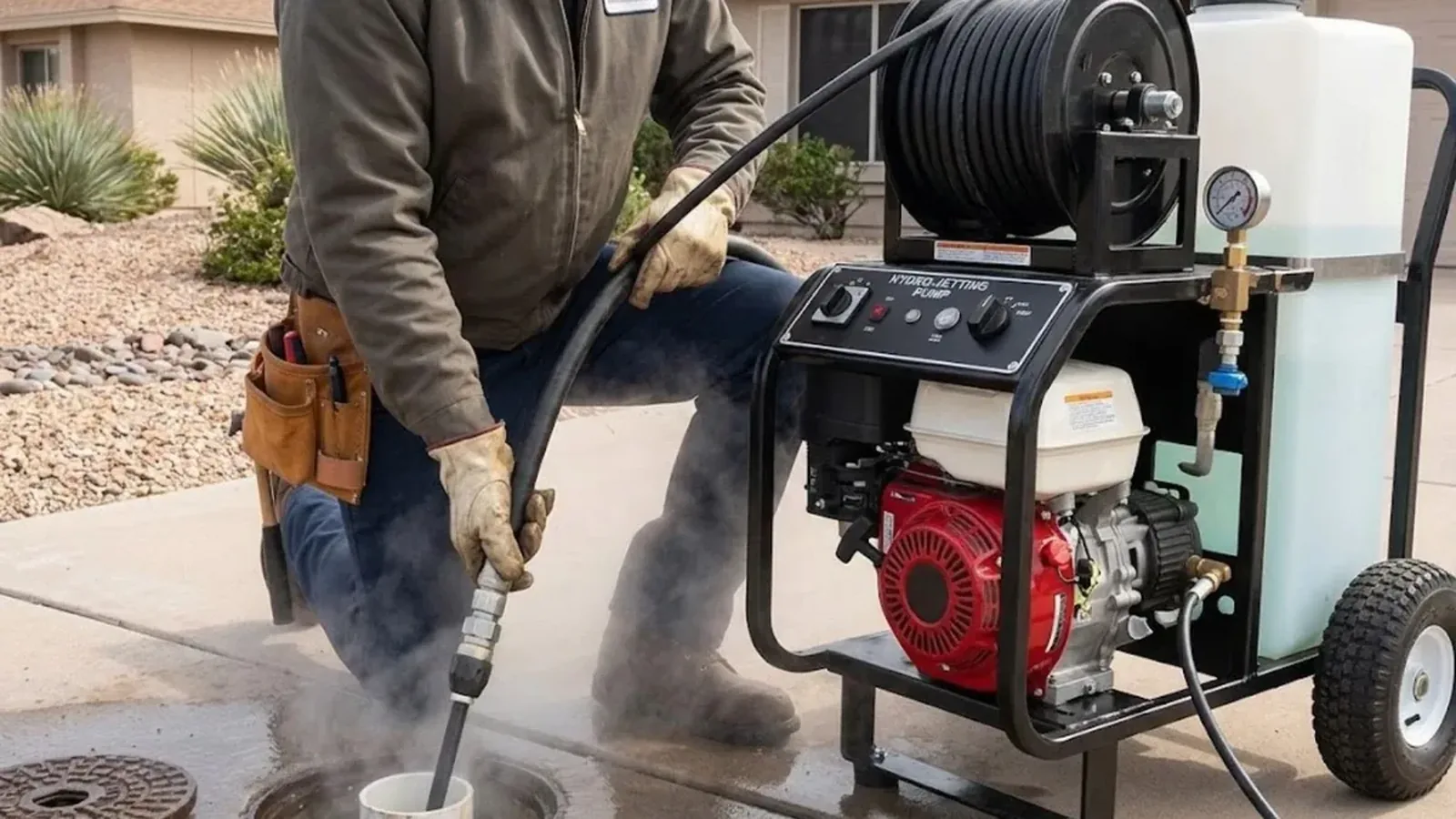
Cable or jetter: which one clears a main line
A cable cuts a path through a clog, and it is quick and cheap. The trouble is that a cable leaves grease and scale on the pipe wall, so the line can clog again in weeks. A jetter flushes that material down the line and leaves the pipe closer to its full diameter.
| Cable (snake) | Hydro jetter | |
|---|---|---|
| Best for | A single soft clog, roots in a small area | Grease, scale, silt, widespread buildup |
| How it works | Cuts or hooks the blockage | Scours the pipe wall with water |
| Leaves behind | A narrower pipe in some cases | A cleaner pipe |
| Risk | Can scratch thin pipe | Not suited to collapsed or badly broken pipe |
How a main line jetting visit works
- Locate the cleanout. The access point for the main line is usually a capped pipe near the foundation, in the basement or in the yard.
- Run a camera first when needed. A camera shows whether the line has a break, a belly or a collapse. Jetting a broken pipe can wash out soil and make the damage worse.
- Feed the nozzle in. The hose carries a nozzle with rear-facing jets that pull it forward and spray the wall.
- Work back and forth. The plumber pushes the nozzle past the clog, then pulls back slowly, scrubbing as it goes.
- Flush and confirm. Water is run through the house and a second camera pass can confirm that the pipe is clean.
Plan for some mess. Water and loosened debris flush through the line, so the plumber will ask you to keep fixtures off during the work and may recommend running a camera afterward. If your home has a floor drain near the cleanout, clear the area around it first.
Roots are a special case. A jetter can cut small roots, but a thick root mass often needs a cutting head first. If roots keep coming back, that points to a gap in the pipe and a repair.
What national guides say about price
National cost guides put hydro jetting a main line at about $250 to $800, though other sources run to $1,400, so roughly $250 to $1,400 across sources. Snaking a main usually runs $150 to $500. A camera inspection is $125 to $500. A severe main with jetting is listed as $300 to $800 or more.
These are national ranges, not local prices. We give a clear price before work starts.
A cheap snake job that returns in a month can cost more over time than one thorough jetting.
Hazelwood sewer ownership and digging notes
The Metropolitan St. Louis Sewer District maintains the public sewers in this area, and the private lateral from your house to the public main is generally the owner's responsibility. Neighboring Kirkwood says the same on its site, and MSD at 314-768-6260 can confirm your own case. That decides who pays when a jetting visit finds a problem past the property line.
If jetting and a camera reveal damage, the repair may involve digging. Call 811 first, as the City of Hazelwood asks, since gas, electric and water lines often run near sewer laterals. Plumbing permits in Hazelwood are handled by St. Louis County through the city.
The International Plumbing Code (IPC) sets minimum drain slope at a quarter inch per foot for pipe 2.5 inches or smaller and an eighth inch per foot for 3 to 6 inch pipe. A line that has settled below that slope will hold water and clog again, however well it is jetted.
What jetting cannot fix
- A collapsed or crushed section of pipe.
- A large offset joint where two sections have shifted.
- A belly, or low spot, that holds water no matter how clean the pipe is.
- Pipe so brittle that pressure could break it, which a camera check should flag.
For those, the answer is repair or replacement. Jetting just gives you a clean pipe to inspect. We do not promise it will end clogs on a line with structural damage.
When to call a plumber
Call when water backs up in the tub, shower or basement floor drain, when toilets gurgle, or when a cable clears the line and it clogs again in a month or two. Homeowner jetting kits that attach to a garden hose have too little pressure to scour a main line, so they will not match a professional unit.
Our hydro jetting service handles heavy buildup, and sewer camera inspection shows what is in the line before any pressure goes in. If the lateral needs a full clean, sewer line cleaning covers it. When a camera finds damage, sewer line repair is the next step. We work in Florissant and Maryland Heights as well as Hazelwood.
Frequently asked questions
It can be, if the pipe is sound. A camera check first tells the plumber whether cracks, breaks or collapse make jetting risky.
A snake cuts or hooks a clog. A jetter uses high-pressure water to scour the whole pipe wall and remove grease and scale.
National guides list about $250 to $800, and some sources run higher, so roughly $250 to $1,400 across sources. Your price depends on length, severity and access.
It clears small roots, but heavy root masses often need a cutting head first. Roots that return signal a gap in the pipe.
The private lateral is generally the owner's responsibility, and MSD maintains the public sewer. Confirm with MSD at 314-768-6260.
Cleaning a line usually does not need a permit, but repairs that follow may. Plumbing permits are handled by St. Louis County through the city.
Questions about your situation? A licensed plumber is on the line any hour.
Call (855) 575-2890