
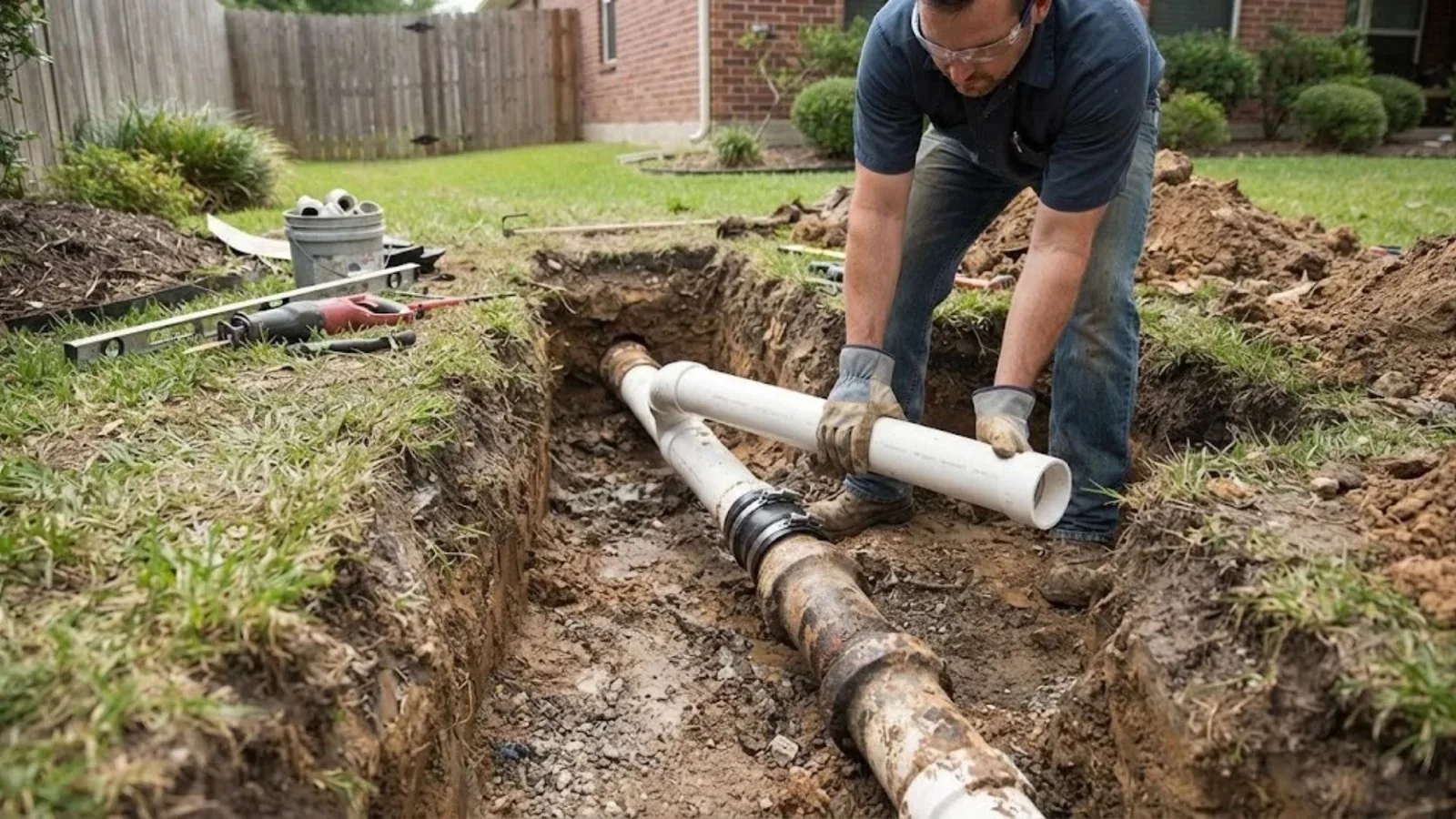
National price ranges for each type of fix
A clog and a broken pipe are two different jobs with two different price tiers. Clearing is machine time. Repair is excavation, lining or replacement, so the numbers climb quickly once the pipe itself is the problem.
| Job | National range | What you get |
|---|---|---|
| Snaking the main line | $150 to $500 | A cable cuts through roots or buildup |
| Hydro jetting the main | $250 to $1,400 across sources | High-pressure water scours the pipe wall |
| Camera inspection | $125 to $500 | A recording shows the cause and location |
| Pipe bursting | $60 to $200 per foot | A new pipe is pulled in as the old one breaks |
| CIPP lining | $90 to $250 per foot | A resin liner cures inside the old pipe |
| Spin-casting | $80 to $250 per foot | A coating is spun onto the pipe wall |
| Cleanout installation | $500 to $2,000 | A new access point on the line |
Overall, national guides put sewer line repair anywhere from $150 to $3,800, with partial repairs often covering 1 to 15 feet and full replacements averaging about 40 feet. Permits add roughly $30 to $500 and concrete removal runs $3 to $8 per square foot where the pipe is under a slab or driveway.
Why a clog turns into a repair bill
Most sewer clogs are not a one-time event. Roots push into joints and grow into a mat, a sagging section holds water and solids, or an old clay or cast iron pipe flakes inside and catches paper. Clearing the line only removes what is there today.
If the line clogs again within a few weeks or months, that usually means the pipe is the problem. A sewer camera inspection shows roots, offsets, cracks and low spots on video, and it settles whether you need another cleaning or an actual repair.
- Cleaning fixes a blockage and costs the least.
- Spot repairs fix one failed section and cost mid-range.
- Relining or replacement fixes the whole run and costs the most.
Who owns the lateral in an MSD area
Hazelwood is served by the Metropolitan St. Louis Sewer District, which maintains the public sewers. The private lateral between your house and the public main is generally the owner's responsibility, a rule stated by neighboring Kirkwood, which is also in MSD territory. That means a clog or break in your lateral is usually your bill, not the district's.
Before you pay for a dig, call MSD at 314-768-6260 and ask where your responsibility ends. If the failure is in the public main, the district handles it. Dial 811 before any digging so buried utilities are marked, which Hazelwood also asks of residents.
A quote for a lined sewer pipe should name the method and its standard, ASTM F1216 for an inverted liner or ASTM F1743 for a pulled-in-place liner. A bid that gives only a price per foot hides the details that decide how long the repair lasts.
What changes the bill on your property
Two houses on the same street can get very different prices for the same clog. These are the factors a plumber weighs once the camera is in the pipe.
Home insurance usually excludes a sewer line that wore out from age or roots. Ask your insurer about sewer backup or service line coverage before you assume you are covered.
What to do while you wait for a plumber
- Stop the water. Skip showers, laundry and the dishwasher so you do not push more into the line.
- Keep toilets unflushed. Flushing sends waste toward the low drain in the house.
- Check the cleanout. If you know where it is, look but do not open it unless you are ready for what may come out.
- Take photos of any water. They help with an insurance claim later.
- Call a plumber. Describe which fixtures are backing up and whether it started suddenly.
A sewer backup is a health problem as well as a plumbing one. Keep children and pets out of the area, and wear gloves and boots if you must clean up.
How to keep the repair price down
Fix a slow main line early. A cable run on a partly clogged line costs far less than a repair after a full blockage has saturated a section of pipe. Ask for the camera video so you can see the damage yourself and compare quotes on the same facts.
If roots keep coming back, regular sewer line cleaning on a set schedule is often cheaper than a one-time lining. Your plumber can tell you whether the pipe is sound enough for that approach.
Sudden gurgling, wet spots in the yard or a sewer smell are other early signs. Call before the line fails entirely.
When to call a plumber and what to ask
Call if more than one fixture is slow, if a tub or floor drain backs up when you flush, or if a recent cleaning did not last. A single slow sink is usually a smaller drain cleaning job.
Ask whether the price covers a camera look, whether permits are included, and what happens if the pipe turns out worse than expected. We serve Hazelwood, Black Jack and Maryland Heights, and we give a clear price before work starts.
Frequently asked questions
National cost guides show about $150 to $500 for snaking the main and about $250 to $1,400 for hydro jetting across sources. Your price depends on access, length and what is blocking the pipe.
Generally yes. MSD maintains the public sewers, and the private lateral from the house to the public main is typically the property owner's. Confirm the exact line with MSD at 314-768-6260.
National ranges are $150 to $3,800 overall. Pipe bursting runs $60 to $200 per foot, CIPP lining $90 to $250 per foot and spin-casting $80 to $250 per foot. Partial repairs often cover 1 to 15 feet.
Usually it makes the price more accurate. National camera costs run $125 to $500, and the video shows whether you need cleaning, a spot repair or replacement.
Plumbing permits in Hazelwood run through St. Louis County via the city. National permit costs range from $30 to $500. A licensed plumber can handle the filing.
Yes. MSD customer service at 314-768-6260 can tell you where the public main starts. That helps you decide whether the failed section is yours or the district's.
Questions about your situation? A licensed plumber is on the line any hour.
Call (855) 575-2890